Two-Person Podcast Clips: Keep Both Hosts in a Vertical Frame
Two hosts at one table, one wide camera? Turn the episode into vertical clips that keep both faces when they fit and follow the speaker when they don't.
On this page
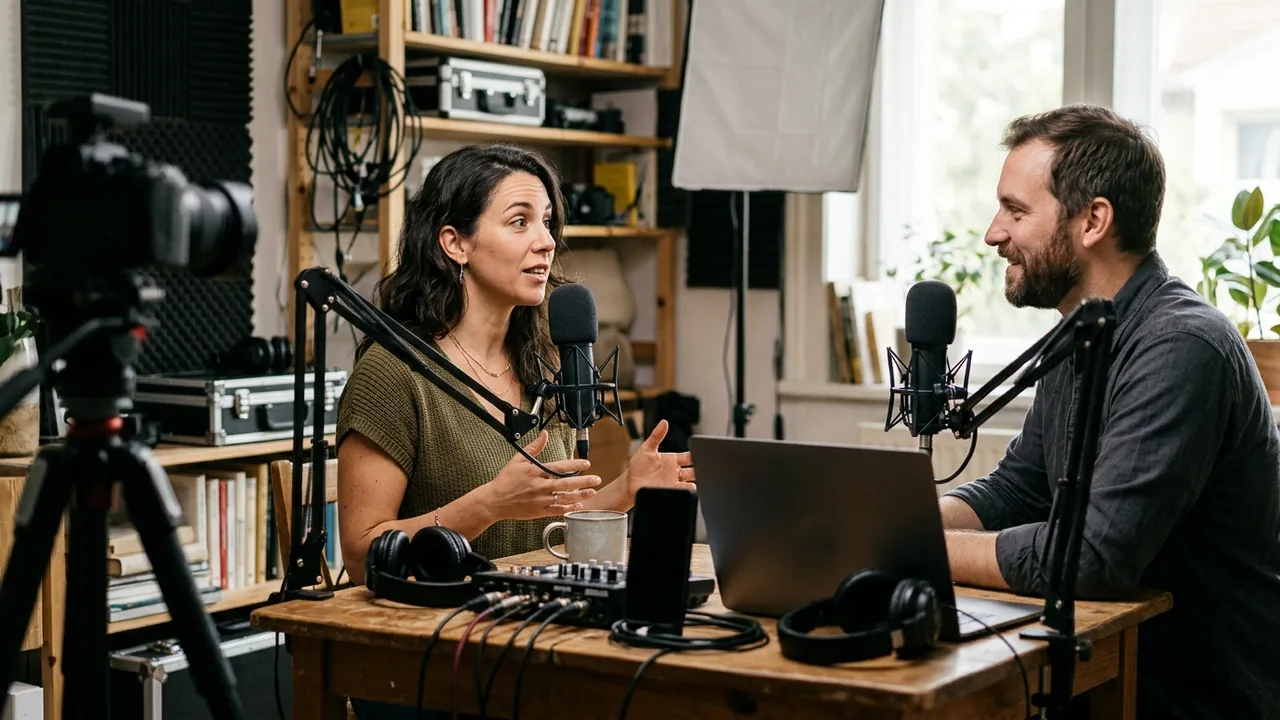
A two-person podcast is usually filmed the simplest way: one camera, one wide shot, two people at a table. It looks great on YouTube. It is also the hardest shot to turn vertical. A 9:16 frame cut out of a landscape image is less than a third of its width, and two people sitting across a table rarely fit in it.
Clipfox handles that shot for you. It finds the faces, decides what the vertical frame can hold, and moves only when it has to.
How Clipfox frames two people
- When you both fit, it keeps you together, with the eyes around the upper third of the frame and the whole head inside.
- When you sit too far apart, the frame goes to whoever is talking and switches when the other host takes over. It waits for a real change of speaker before moving, so the frame does not flicker on every short interjection.
- When you barely move, it holds one steady frame instead of drifting. When you lean or turn, the camera follows smoothly.
- When the episode is edited from several cameras, each camera change counts as a cut, and the frame jumps with it.
The cutting itself is the same as for any episode: the AI picks moments that make sense on their own, cuts on complete sentences and burns in captions.
Set up the shot for vertical clips
- Sit closer than feels natural, or angle both chairs toward the camera. The closer you are, the more often you both stay in the vertical frame.
- Keep both faces visible. Clipfox frames people whose face it can see. A host filmed in strict profile, or hidden behind a microphone, is harder to frame.
- Film in 4K if your camera can. From a 1920×1080 image, the vertical slice is 607 pixels wide. From a 4K image, it is twice as wide, and the clip stays sharp. Pro exports up to 4K when the source has it.
Square when both of you must stay in
The 1:1 square uses the full height of the image and a much wider slice of it: 1080 pixels out of a 1920×1080 frame, against 607 for vertical. Two people sitting near each other stay in the frame far more often. For a duo whose chemistry is the show, square suits feeds such as Instagram or LinkedIn, and vertical suits TikTok and Shorts. The trade-offs are explained in vertical, square or landscape.
The moments that make the best duo clips
A disagreement, a running joke, one host explaining something to the other: the exchange between you is what a single-speaker clip cannot give. Use the Instructions for the AI field to ask for it, for example "moments where we disagree", and choose Most engaging as the goal.
If your episodes are guest interviews, see interview podcast clips.
Turn your next episode into clips: 30 free minutes every month with a free account.